This side will be new arranged
MT
Yemenite
Manuscripts
| Bible
Manuscripts - Tora (Tag')
Tag' is the classic Yemenite Pentateuch. The biblical text together with the Targum, the aramaic translation. Only in Yemen the Tora is read together with the aramaic translation, verse by verse, even today in the Yemenite Synagogues in Israel. Sometimes the arabic translation by Saadja Gaon is added as well as the commentary of Rashi. The targum and the Rashi commentary are usually not copied from the prints, have many variants and are of scientific importance. |
|
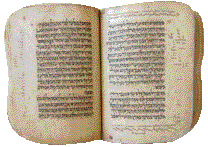
Tag' Bereshit and Shemot written from a professional scribe in a very fine manner. At the beginning the Hebrew, Aramaic and Arabic are verse after verse. The Hebrew ist with Tiberian vocalisation, the Aramaic with Babylonian (supralinear) vocalisation and the Arabic is as normally without vocalisation, but with diacritical points. In the later part the Hebrew is in the middle, on the inner side is the Arabic (on the picture to the left) and the Targum on the externial side (here right). Two pages are from a later hand and have a commentary (Rashi). The manuscript ist probably from the 16th century. The cover is original leather, but in a bad condition. Most of the manuscript is in a good condition. Some pages are damaged. There are some Hebrew and Arabic fragments in the binding. 274 pages 2400.- Euro .....................................................................................................................4158 |
| |
|
Bereshit Genesis only with the Armaic Targum On the right side is allways the Hebrew Bible text, on the left side the Aramaic targum (translation). The script is very special and not from a professional scribe. The manuscript comes apparantly from a village in one of the remote districts of Yemen. On the picture is one of the left sides, the Aramaic text.
480 Euro ........................................... 2432
|
||
Haftarot
There are many differences between the Yemenite Haftarot and the Haftarot of
other eastern communities. However in between the Yemenite manuscripts too
there are a lot of differences according to time and certain region in the
country and between town and villages. So every manuscript has a scientific
value. The Sana and Aden Haftarot were printed for the first time at the end
of the nineteenth century. The manuscripts below are older than this. Most
of the manuscripts contain the Hebrew text followed verse by verse by the
Targum, as it is read in the Yemenite Synagogue until today.
|
Haftarot with Targum
226 pages,
19th cent., big format 320 Euro .............................................................................................................................3436 |
|
|
Liturgy
Shir ha-Shirim,
with Targum and Rashi
Fragment Kap. 1,1-4.9
The commentary of Rashi exists till page 6b, after this there is empty room for the commentary, but he is missing. Maybe the scribe couldn't find a text to copy or he couldn't end his work. After Shir ha-Shirim are some pages with the Tikun Shavuot. It ended in the middle of a page and was not continued. The pages are not bound and are inside of a hardcover. The manuscript is from the 19th century, 24 pages
There are differences in text and vocalisation in the Targum and in the Rashi commentary compared to the printed texts.
90,- Euro...............................................................................................................................4159
Prayerbooks from Yemen
|
|
Part of a Prayerbook from Yemen
96 pages. In a case
Two manuscripts. The manuscripts contains prayer Azharot, the Keter Malkut by Ibn Gabirol, Ashmurot and Hoshanot. The Beginning of the first manuscript is missing, the end exists. The text of the manuscripts is partly vocalised (babylonian, supralinear).
18th and 19th cent.
310,- Euro .....................................................................................................................................2209
|
Prayerbook
|
|
|
Modern hardcover The manuscript contains the prayer for Simhat Tora with the Hoshanot, the order of nullifying oaths (seder hatarat nedarim) and curses (hatarat Klalot), the Selichot prayers (seder Selichot leleile Ashmurot), the Tachanot prayers, Selichot for blowing the shofar on the New Year. The manuscript is complet and very well preserved. It is from the 19th century. 172 pages 320,- Euro .................................................................................................................................. 1608
Old Fragment of a prayerbook
26 pages in a case The vocalisation is Babylonian (supralinear). The fragments contents parts of the Jom Kippur prayer, Slichot and Tachanot. There are some funural orations (hespedim). The pages are from the 17th century. 250,- Euro .......................................................................................................................748 |
Pessah Haggadot from Yemen
There are a lot of differences between the Yemenite Haggadot and the other
Oriental Haggadot. There is a much longer bracha of the day, many additions
and variants in the normal texts. But even in Yemen there are differences
from place to place, between towns and villages and so on. The first printings
of the Yemenite Haggadot were done in the end of the 19 century. All the manuscripts
offered here are older than these printings and are different from them and
between themselfs.
|
|
Pessach Haggada 18. Century
360 Euro
2674
|
|
Pessah Haggada according to the Yemenite rite. The manuscript begins in the middle of the story of the Sages in Bne Brak. The text is according to the Yemenite rite. In the middle of the dayenu poem is an inclusion of the Aleppo Haggadot about bizat ha-yam and bizat mitzrajim. The first leaf is missing and between the leaves three and four one double leaf is missing. Paper, Yemen, 18th or early 19th century, 10 pages, bound in modern cardboard. Size: 4.2 x 6.2 inch Very rare. It can show some wear because of its age - as you can see in the pictures. 280 Euro 3619 |
from Yemen: Pijutim, Songs and Hymns
|
Hebrew and Arabic Pijutim, 17 pages, the cover is an old leather piece from a Torascroll, written only on one side, The fragments contains part of Genesis chapter 47. The fragment is maybe from the 16th century. The manuscript is from the 19th century. some of the pijutim are unpublished and even unknown. 320. Euro
3503 |
|
| the old cover of the manuscript | |
|
|
|
Pijutim, Bakashot (Hymn) in Hebrew 3 manuscripts or fragments are bound together, the first one is complete, but completed by a later hand. The vocalisation in mainly in Babylonian (supralinear). Most of the manuscripts are from the 18th century. 56 pages 280 Euro
1377 |
||
|
Divan The yemenite Divanim are very common and content holy and secular songs in Hebrew and Arabic, and sometimes in both languages. The most common poet in Yemen was Shalem Shabazi. His songs are in the most Divanim
This Divan is in the original leatherbinding with leather clasps.The manuscript is complete. On the end is a register of all the songs in the Divan. After the Pijutim are the blessings for mariage. The manuscript ist from the 19th century, 154 pages 280,- Euro...................................................................................................3799
|
||
|
Ibn Gabirol: Keter Malkut ("crown of royalty") Keter Malkut is one of the greatest poems of Spanish Jewish culture, written by Shlomo Ibn Gabirol Keter Malkut ("crown of royalty") The mark of the sovereignty of God, recognized by angels and men in worshipping him. It is also the name given by Solomon ibn Gabirol to his poem in praise of God, which is recited after the evening service on the Day of Atonement. Solomon ibn Gabirol, also Solomon ben Judah was an Andalucian Hebrew poet and Jewish philosopher. He was born in Málaga about 1021; died about 1058 in Valencia. Gabirol was one of the first teachers of Neoplatonism in Europe. His role has been compared to that of Philo. Philo had served as the intermediary between Hellenic philosophy and the Oriental world; a thousand years later Gabirol occidentalized Greco-Arabic philosophy and restored it to Europe. 24 pages, modern hardcover 280 Euro ........................................................................................................2950
|
|
It is held by some scholars that Ibn Gabirol set out to reconcile Neoplatonism with Jewish theology. Geiger finds complete harmony between Gabirol's conception of the Deity and the historical Jewish conception of God; and Guttmann and Eisler hold that in Gabirol's doctrine of the will there is a departure from the pantheistic emanation doctrine of Neoplatonism and an attempted approach to the Biblical doctrine of creation. A suggestion of Judaic monotheism is found in Gabirol's doctrine of the oneness of the "materia universalis." The Neoplatonic doctrine that the Godhead is unknowable naturally appealed to Jewish rationalists, who, while positing the existence of God, studiously refrained from ascribing definite qualities or positive attributes to God. Ibn Gabirol strived to keep "his philosophical speculation free from every theological admixture." In this respect Gabirol is unique. Gabirol's contribution to Kabbalah was that God is an Absolute Unity,in whom form and substance are identical.Therefore no attributions can be ascribed to God,and man can comprehend God only by means of the beings emanating from him.Gabirol mentioned the four worlds as Beriah,Yetzira and Asiya,while he considered Atzilut to be identical with the Will. Ibn Gabirol is best known for his sacred poetry and is recognized as one of the most prominent and seminal of the medieval Spanish-Jewish religious poets. His mastery of the Hebrew language, his deep and austere religious feeling, and his familiarity with Arabic prosody combined to produce a body of sacred verse that entered the Jewish liturgy in all rites---Sephardi, Ashkenazi, and Karaite. His works are characterized by a deep reverence for God and identification with the tribulations of the Jewish people in exile as well as hope and confidence in the redemption. His most famous poem is the philosophical meditation Keter Malkhut ("Royal Crown"), which is also a prayer written from an awareness of the triviality of man as compared with the greatness of God, Who is called upon for His mercy and forgiveness. It entered the Sephardi ritual for the Day of Atonement. Thou art the light hidden in this world and revealed in the world of beauty, 'In the mount of the Lord it shall be seen.' Thou art the eternal light, and the inward eye yearns for Thee and is astonished - she shall see but the utmost part of them, and shall not see them all. (excerpted from The Kingly Crown, Section One, The Praises of God) The manuscript offered here, is complete . Is contains the text according to the Yemenite Tradition, it has some different readings compared to the text in the first edition of the Yemenite Mahzor Mekor Hajim, Jerusalem 1896. It has the supralinear (Babylonian) vocalization.
|
Halacha Law The law of slaughter
The manuscript contains the Halachot Shaare Kedusha (the gates of Holy) and Jemin Moshe (the rieght hand of Mose, two very important collections of the laws od slaughter. On the end of the manuscript is another order of nullifying curses (hatarat Klalot). 208 pages, 19th century. Original leather binding 270 Euro........................................................................................................................................................430 |
Old Fragments in Bindings
On the left side: Maimonides, Mishne Tora, Halachot Para Aduma (the red Heiver), cahpter 13, 16th century
on the reigt: Mishna Baba Metzia, end of chapter 1 and beginning of chapter 2. with the commentary of Maimonides in the original Arabic (in Hebrew letters) 14th or 15th century.
180,- Euro ...............................................................................................................................3147
Maimonides and Tag'
The right side (Picture) is a page from the Halachot Tefila, end chapter 4 and beginning of chapter 5 of the Mishne Tora. The headlineis in the style of manuscripts of the 13th century decorated and coloured. It is a very early fragment short after the death of Maimonides.
The left side (not in a picture, is an old fragment of a Tag' from the 16th century, with the hebrew Bible Text in Babylonian vocalisation (for Bible texts very seldom) follosed always by the Targum in Aramaic, also in Babylonian voclisation. The text is from Numeri chapter 28.
300,- Euro ....................................................................................................................................192
Lieferungsbedingungen
Preis in Euro, jeweils Porto und Verpackung inbegriffen.
Lee Achim Sefarim, P.O.B.7682, Jerusalem 91076. Fax +972–2–6448151 E-mail:
michaelkrupp@bezeqint.net
Conditions of sale
Prices in Euro or equivalent currencies to the stated price in Euro including
mailing costs. Contact: michaelkrupp@bezeqint.net